Preparative Workflow
Preparative Chromatography Course
1 - Fundamentals of Preparative Chromatography
3 - Preparative Chromatography Instrumentation
4 - Key Considerations: Part 1
5 - Key Considerations: Part 2
6 - Column Selection
7 - Automated Preparative Purification Instrumentation - UFPLC
8 - Automatic Analytical to Preparative Scale Up
9 - Triggering Fractionation
10 - Preparative SFC
11 - Course Summary & Test

Preparative Workflow
Welcome to this next section of our journey, where we will look at the typical workflow most analysts use for preparative chromatography.
Defining the Separation Strategy
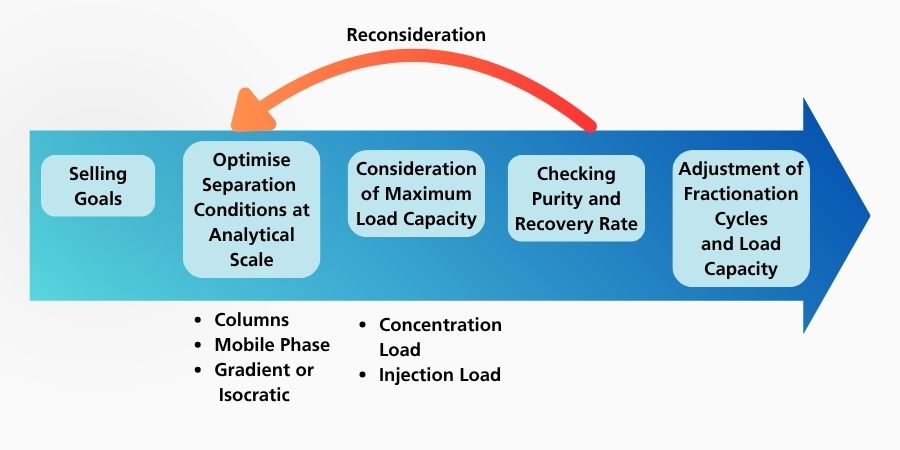
Understanding the objective of the separation, including establishing the acceptable yield limits and purity requirements, is an important factor to consider. Usually, the separation method is started on an analytical scale to establish the stationary and mobile phases along with the elution mode. Key considerations, such as the optimal order of elution, must also factored; these will be discussed in greater detail in Course Unit 4
Developing the Purification Method
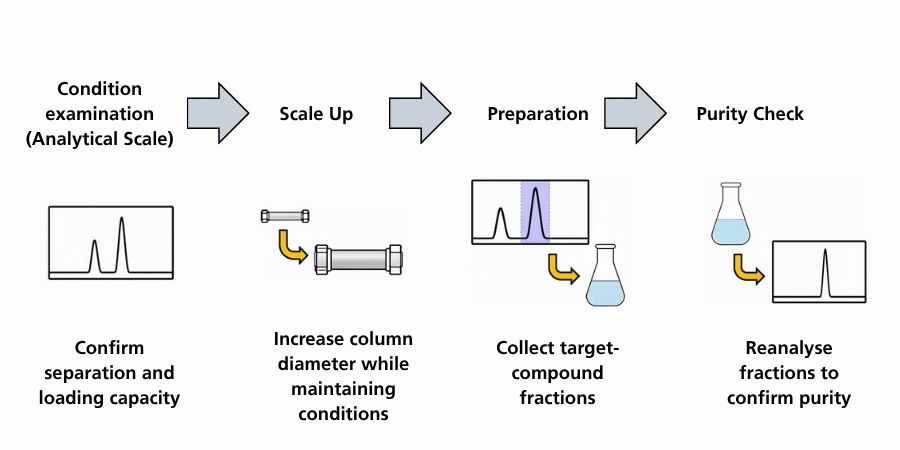
After the analytical method is created, a loading study can be performed to determine the maximum load that can be reliably collected in the purification step. This would consider the sample’s concentration alongside the amount injected into the column. The required load influences the internal diameter of the stationary phase; therefore, any changes in internal diameter, including injection volume and flow rate, would need to be accounted for by scaling the analytical method.
Next, the separation analysis is performed at preparative scale, with the target compound fractionated from the mixture. Once complete, the purity is assessed by reanalysing the collected fraction on the analytical liquid chromatograph. The purity needs to be checked by reanalysing the collated fraction on the analytical LC to confirm purity.
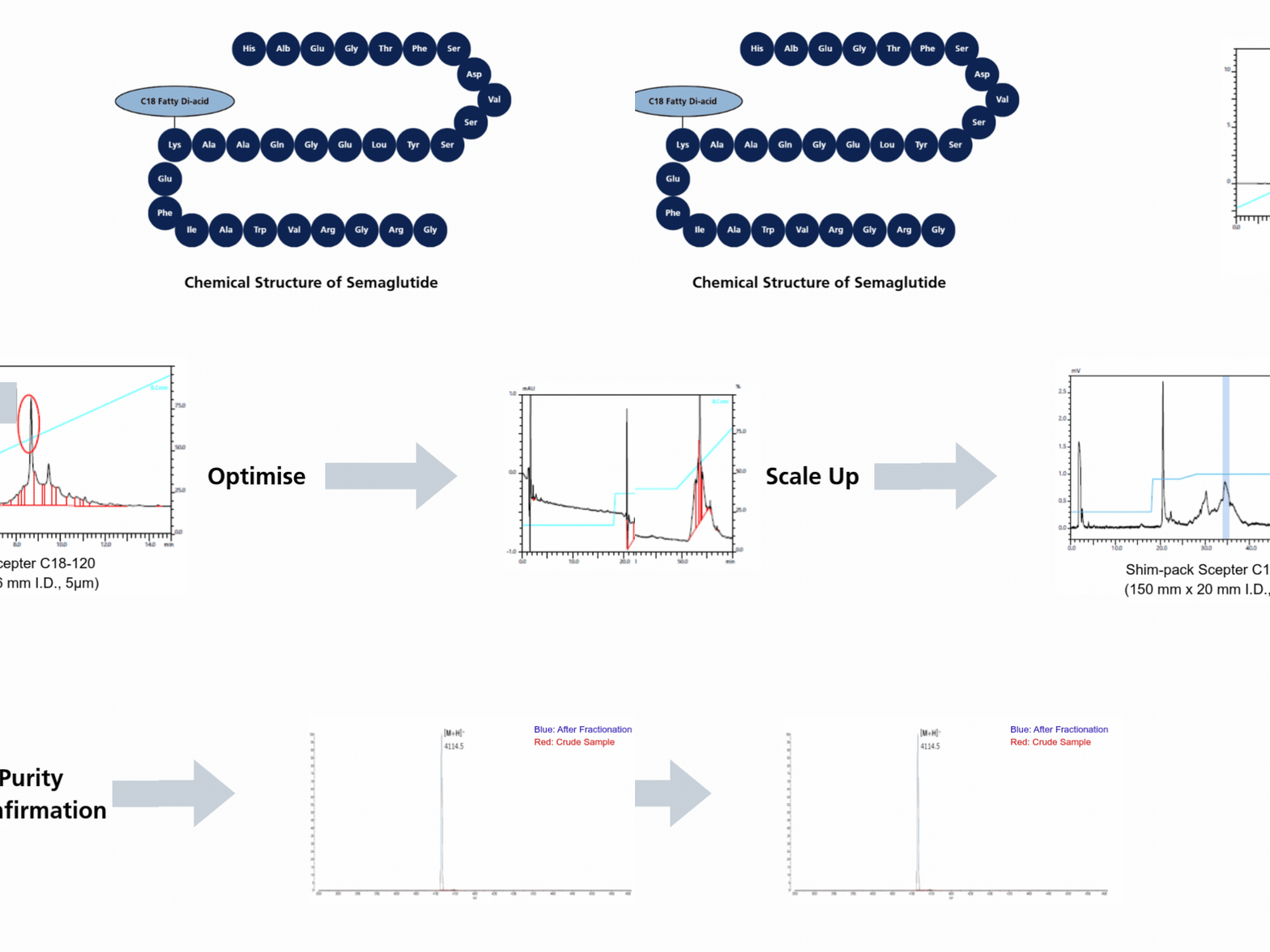
Preparative Purification Example
Here is an example of fractional purification of a crude synthesised peptide as seen on the left. The method was first developed on the Shim-Pack Scepter C18-120, 150 x 4.6 mm, 5 μm column format using a linear gradient. The method was not satisfactory; therefore the method was optimised with a step gradient and shallower slope, which resolved the peak sufficiently from the impurities. This was scaled up to the Shim-Pack Scepter C18-120, 150 x 20 mm, 5 μm column format, where the injection volume and flow rate were adjusted. The crude sample (red trace) and the peptide after fractionation (blue trace) were then reanalysed, where we can see there is nothing left in the crude sample, and a nice signal for the peptide fraction with good purity.
Over the next few course units, we will look at the components that make up a prep instrument and the critical parameters that impact our chromatography.
Best regards,
Your Shimadzu Chromatography Team
Related Resources
-
-
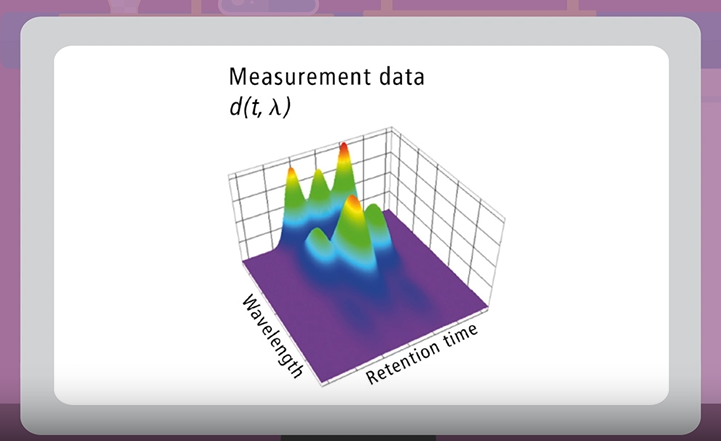
Watch short videos explaining analytical intelligence features of Shimadzu HPLC systems
-