Changes in Chromatographic Resolution
LCMS Troubleshooting Course
11 - Retention Time Fluctuations - Part 2
12 - Changes in Chromatographic Resolution
13 - Changes in MS Response
14 - Undesired Fragmentation & Ion Source Settings
15 - Course Summary & Quiz
Changes in Chromatographic Resolution
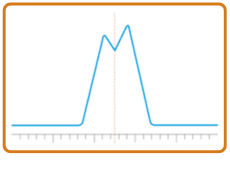
Chromatographic resolution is different to resolution often discussed in mass spectrometry. Although the mass spectrometer is extremely powerful at analysing compounds by mass, we still require chromatography to generate a robust and reliable methodology for our analysis. This is particularly true for isobaric species, such as regioisomers, which cannot be distinguished by mass. In this circumstance, we need to have chromatographic resolution to separate all compounds of interest to definitively identify each analyte. We might also have compounds which cause other analytes ion suppression which is detrimental to analysis. By altering the chromatographic conditions, we can resolve those compounds and ensure they do not negatively impact on the detection.
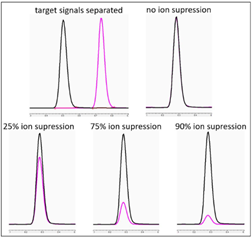
Fig. 1 Illustration of ion suppression caused by coeluting peaks
| Cause | Description | Solutions |
|---|---|---|
| Changes in Peak Shape | Chromatographic resolution is dependent on peak width and retention time. If there are changes in peak shape, this can cause changes in resolution. |
Check for changes in column performance, using a system suitability test mixture.
Check the sample load is consistent, by checking the sample preparation and the batch for injection volume. Reprepare samples if appropriate.
Replace the stationary phase if column has degraded.
Ensure the correct ionic strength is used on the mobile phase
Check the connection between the column and the system in case of extra band broadening effects. Check the flow path has not been altered with additional volume added or removed.
|
| Changes in Retention Time | As previously mentioned, peak width and retention time are used to calculate chromatographic resolution, therefore changes in retention time can cause changes in resolution values. For greater detail, see earlier sections on peak retention fluctuation. |
Check the flow rate, temperature and other method parameters
Ensure sufficient equilibration
Ensure the system is correctly working (i.e. pumps, autosampler, column oven)
Reprepare mobile phases and dispose of in an appropriate timeframe.
Ensure the column format is correct (particle size, length, ID)
|
In the next unit of the course, we will investigate changes in MS response, which includes changes in mass accuracy, MS resolution and issues within the MS instrument.
Your Shimadzu LCMS Team
Related Resources
-
-
Watch short videos explaining analytical intelligence features of Shimadzu HPLC systems
-